Third Country Removals: A World Map of Where People Are Sent
Some people a U.S. immigration judge has ordered removed cannot be sent home: the judge found they would likely be persecuted or tortured there, and the law forbids returning them. DHS sends them somewhere else instead. Since 2025 it has done so under guidance that allows removal to a third country on as little as six hours' notice, or none at all where that country has given diplomatic assurances. That guidance is the practice the Supreme Court will weigh in Department of Homeland Security v. D.V.D., argued December 9.
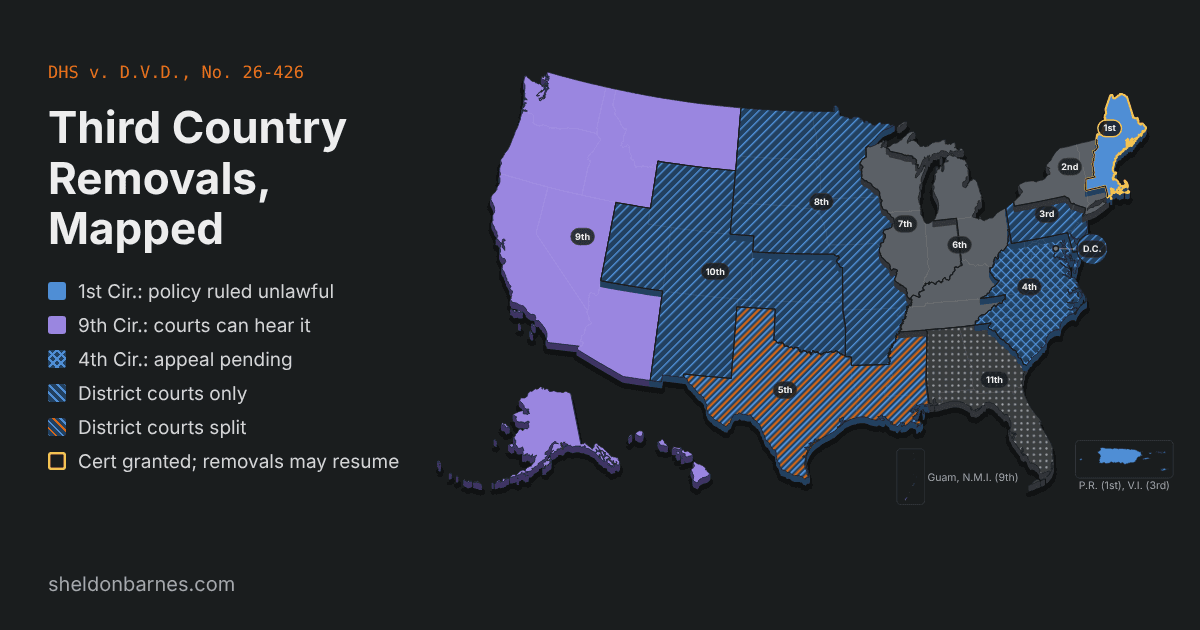
This page maps where people are actually going. For how the federal courts have handled the policy — the one appellate ruling, the thousands of habeas petitions filling the gap, and the jurisdiction question the Justices will reach first — see the companion court-decisions map.
Why a third country
In most of these cases, the home country has not refused to take the person back. The United States has barred sending them there. An immigration judge ordered the person removed but also found that they would probably be persecuted or tortured at home, and once that finding is made, the law forbids returning them to that country.
The protection comes in two forms. Withholding of removal under 8 U.S.C. 1231(b)(3) bars removal to a country where the person's life or freedom would be threatened because of race, religion, nationality, membership in a particular social group, or political opinion. Protection under the Convention Against Torture, which Congress implemented through FARRA in 1998, bars removal to a country where the person would more likely than not be tortured by public officials or with their acquiescence, and it requires no link to any of those five grounds. Both are mandatory. Both are also tied to one country. Neither gives the person lawful status or cancels the removal order, so, as the Supreme Court put it in Nasrallah v. Barr, a person granted CAT protection "may be removed at any time to another country where he or she is not likely to be tortured."
The cases follow that pattern. In 2006 an immigration judge ordered the petitioner in Ansumana S. removed "to any country other than the Ivory Coast that will accept him"; DHS later tried to send him to Sierra Leone. The petitioner in Lopez is a Bolivian woman granted withholding and deferral of removal under CAT as to Bolivia; DHS arranged to send her to the Congo. The opinions rarely say why the immigration judge granted protection, because a habeas court cannot review that finding and the petitioner is not challenging it. Arostegui-Maldonado v. Baltazar is the exception, because his protection claim was still being litigated. He is a citizen of Costa Rica and El Salvador who testified that Costa Rican police officers beat and raped him. After his 2022 removal, he says, officers at a Salvadoran checkpoint saw his DHS deportation paperwork, beat him, and branded him with a piece of rebar heated in a tortilla vendor's fire.
A smaller group really does have nowhere to go. ICE holds them while it looks for a country that will take them, and their petitions usually pair a third country claim with a prolonged detention claim under Zadvydas v. Davis. Sometimes the search fails outright. In Quiroz Zapata v. Mullin, a court ordered the return of a Colombian woman who had been sent to the Congo, which had not agreed to accept her.
Where people are being sent
Interactive map
Where people are being sent
Documented transfers through Sept. 10, 2026. Each line runs from a home country to the third country that received the person. Select a country, a line, or a court case.
The agreement- and assurance-based removals at the center of D.V.D.: people with final orders, most protected by a judge from return home, flown to countries that agreed to take them, mostly in Africa. Mexico, where the far larger land-border volume goes, is under the Americas view.
609
people documented
22
destination countries
67
home countries
Tap a continent label to focus a region. Scroll or pinch to zoom, drag to pan. Tap a pin, a ring, or a line for detail.
Destinations, by people received
Home countries, by people documented
Court cases on these routes
Counts are documented minimums, compiled from Third Country Deportation Watch (as of Sept. 10, 2026), the ICE removal records analyzed by Human Rights Watch, and the USCRI tracker. A line's width counts only people whose nationality was reported, so destination totals run higher than the lines into them. Home country means nationality, except in the Other view, where it marks the birth country. Some people were later sent on from the destination, often back to the home country a U.S. judge had protected them from.
The map traces every route the public trackers have documented, from home country to destination, 231 in all, from 77 home countries to 34 destinations. The removal deals view is the practice D.V.D. is about: people with final orders, most of whom a judge protected from return home, flown to countries that agreed to take them — about 600 people to 22 countries, most of them in Africa. Ghana, the largest, has taken about 110.
By raw volume, though, the largest third country destination by far is Mexico. Mexico's migration institute counted more than 18,000 non-Mexicans received at the land border since January 2025, mostly handed over under an unwritten arrangement; DHS told a federal court that 7,257 of those were formal removals it had carried out — already more than every African deal combined. How much of that is a third country removal in the D.V.D. sense is contested: the formal removals of people with final orders fit the class, but the pushbacks and the asylum seekers turned back without any removal order do not. Because the Mexican count blends the two and the formal share cannot be separated out by nationality, I keep Mexico in the Americas view rather than the removal-deals view — switch to Americas or All to see it. Guatemala and Honduras in turn take Mexicans and bus them home, and Asylum Cooperative Agreements send asylum seekers to Honduras, Ecuador, Paraguay, Uganda, and Belize before any U.S. judge hears their claims — different legal pathways with their own litigation. The DHS guidance still reaches the formal removals to Mexico, including the one in Ibarra-Perez.
Two cautions about the numbers. They are a floor: the trackers count only what governments, journalists, and lawyers disclose, and Human Rights Watch found removals in ICE records that the trackers had missed, including 17 people sent to Egypt and 20 to Kenya. And a destination is not always the end of the line. Several of these countries have sent people onward to the home countries that U.S. immigration judges had protected them from, which is the risk the D.V.D. plaintiffs say notice and a fear screening exist to prevent.
Sources and method
The route map is built from the country pages of Third Country Deportation Watch (updated September 10, 2026), the ICE removal records analyzed in Human Rights Watch, "To Scare People": US Expulsions of Third-Country Nationals to Countries in Africa (Oct. 8, 2026), and the USCRI Third Country Deportations Tracker; a line counts only people whose nationality was reported, and a dashed line means a nationality was reported without a count. Background on the guidance comes from the Congressional Research Service, Immigration Removals to Third Countries (Aug. 24, 2026).
Mexico sits in the Americas view, not the removal deals view. DHS told a federal court it had formally removed 7,257 third country nationals to Mexico as of March 2026, and those formal removals of people with final orders are D.V.D.-type; but the Mexican-government count that the route lines draw on blends them with land-border pushbacks and asylum-seeker turnbacks that are not, and the formal share cannot be separated out by nationality, so I keep the whole of Mexico under Americas rather than apportion an estimate into the removal deals view.
The counts are documented minimums: the trackers record only what governments, journalists, and lawyers disclose. All materials were retrieved in October 2026. If you know of a transfer I missed, tell me and I will add it.
Share this post