Third Country Removals, Mapped: One Circuit Ruled, and Everyone Else Went Through Habeas
On September 29, the Supreme Court stayed the First Circuit's judgment in D.V.D. v. Department of Homeland Security, treated the government's stay application as a petition for certiorari, and granted it the same day. The case is now Department of Homeland Security v. D.V.D., No. 26-426, and it will be argued December 9.
The stay is easy to misread. It did not stop third country removals. It paused the judgment that had blocked them, so DHS may carry out third country removals under its 2025 guidance while the case is pending. The only people protected in the meantime are those with their own court orders.
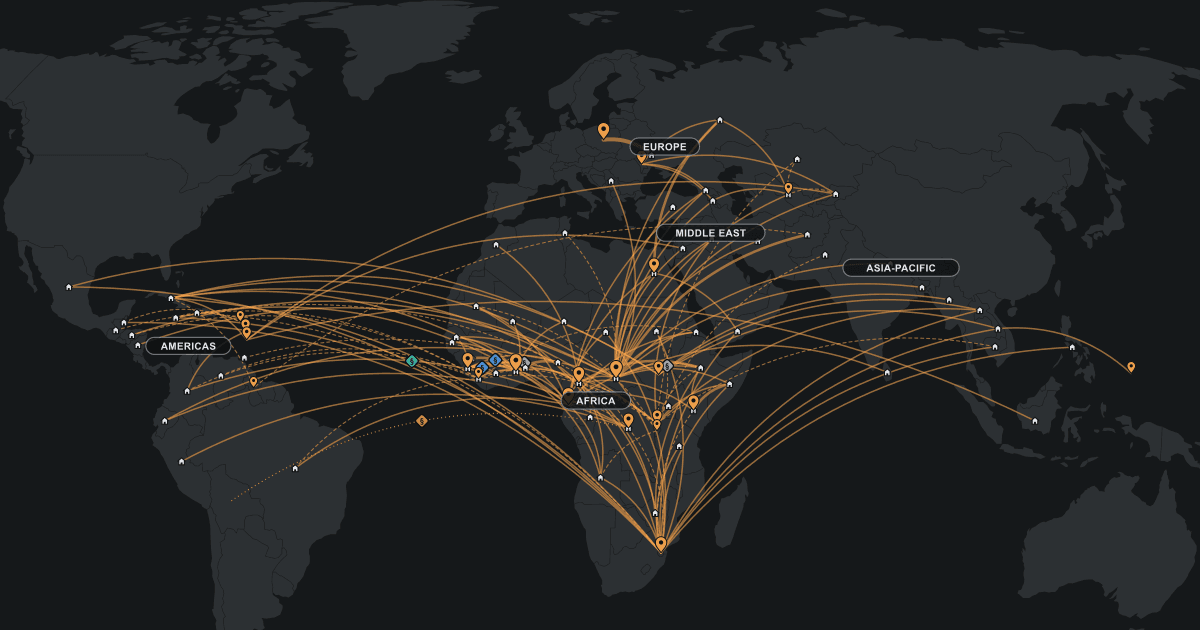
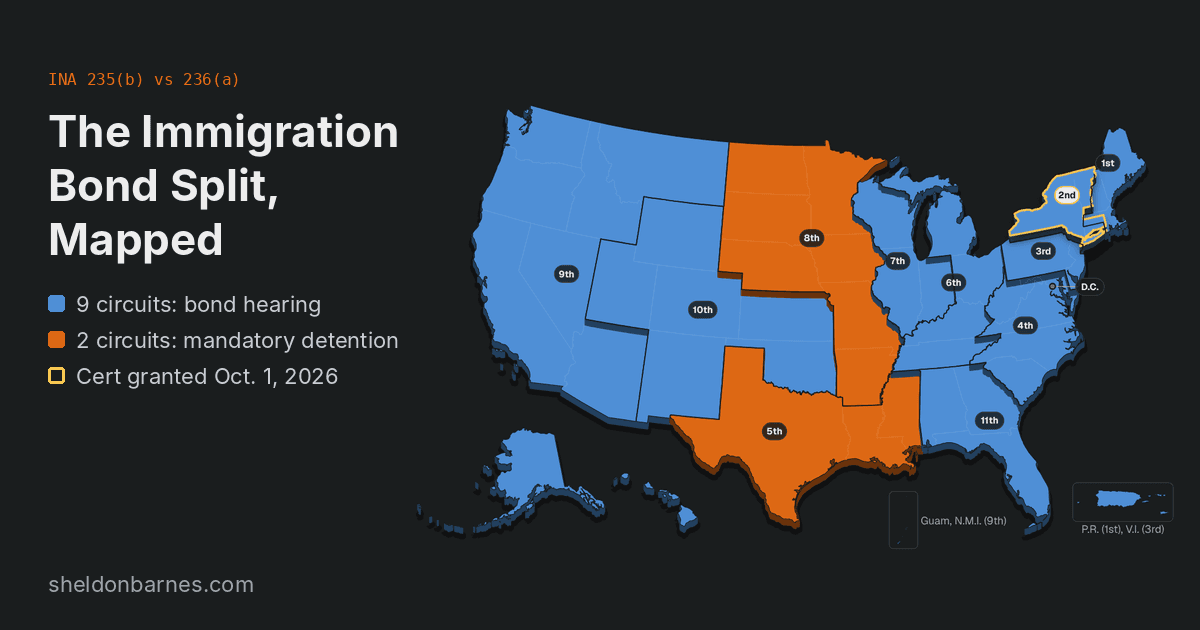
I built the bond split map because eleven circuits had answered the same question. This case is different. The third country question never produced a split on the merits, and the reason why is the most interesting thing about it. This page shows what the courts have done anyway, with links to every opinion and order. For where these removals actually send people, see the companion world map of third country removals.
The question
When an immigration judge orders someone removed but grants withholding of removal or protection under the Convention Against Torture as to their home country, DHS may still send that person somewhere else. In March 2025, and again in July 2025, DHS issued guidance on how. Where a receiving country gives diplomatic assurances, the guidance allows removal with no notice at all. Otherwise it allows removal 24 hours after notice, or as little as 6 hours in undefined "exigent circumstances," with a fear screening only if the person raises a fear on their own.
A nationwide class challenged that guidance in the District of Massachusetts. The district court set it aside, and on September 18, 2026 the First Circuit largely affirmed, holding that the statutes and regulations require meaningful notice and a meaningful opportunity to raise a fear of persecution or torture before removal to a country not named in the removal order.
The Supreme Court directed the parties to brief four questions: whether the district court had jurisdiction; whether 8 U.S.C. 1252(f)(1) allowed classwide declaratory relief and APA vacatur; whether the guidance is unlawful under 8 U.S.C. 1231(b), the Due Process Clause, or FARRA and the CAT regulations; and any other question the government thinks necessary.
Where people are being sent
Most of this activity happens far from any courtroom. The agreement-based removals at the center of D.V.D. — people a judge mostly protected from return home, flown to countries that agreed to take them — are a few hundred people to about 22 countries, most of them in Africa. By raw volume the largest destination is Mexico, where DHS reported 7,257 formal removals as of March 2026 among a much larger land-border flow. I mapped every documented route, from home country to destination, on a companion page: a world map of where third country removals send people. It also explains who these people are and why the law bars sending them home.
Where things stand right now
Court orders have switched the guidance on and off six times since April 2025. For most of that time, it has been in effect.
| Period | Status of the guidance | Why |
|---|---|---|
| April 18 to June 23, 2025 | Limited by court order | The District of Massachusetts required written notice and a chance to raise fear claims before any third country removal |
| June 23, 2025 to February 25, 2026 | In effect | The Supreme Court stayed that injunction without explanation |
| February 25 to March 16, 2026 | Set aside | The district court entered final judgment vacating the guidance |
| March 16 to September 23, 2026 | In effect | A divided First Circuit panel stayed the judgment pending appeal |
| September 23 to 29, 2026 | Set aside | The First Circuit affirmed and dissolved its stay |
| Since September 29, 2026 | In effect | The Supreme Court stayed the judgment and granted certiorari |
Three things follow. First, DHS can use the full guidance today, including removal with no notice at all to a country that has given diplomatic assurances, and removal 24 hours after notice, or 6 hours in exigent circumstances, everywhere else. Second, the stay is not a ruling on the merits; the Court will decide whether the guidance is lawful after the December 9 argument, most likely by the end of the Term next summer. Third, the Supreme Court's order reaches only the classwide judgment. A district court order protecting a specific person, like those in Ansumana S., Cruz-Medina, or the Fourth Circuit's stay in Bojorquez, still binds the government for that person. That is why individual habeas petitions remain the only way to stop a particular removal while the case is pending.
Where each circuit stands
Interactive map
Where each circuit stands
Status as of October 10, 2026. Select a circuit to see its cases.
Policy in effect since September 29, 2026. DHS may carry out third country removals under its 2025 guidance while the Supreme Court decides the case. Only people with their own court orders are protected in the meantime.
Where courts have ruled on how DHS sends people to countries not named in their removal orders. Solid fill means a court of appeals ruled; crosshatch means an appeal is pending; striped fill means only district courts have acted. Select a circuit for the cases.
court of appeals has ruled on the policy (1st)
more circuits where district courts stopped removals, one with an appeal pending (4th)
argument in DHS v. D.V.D.
An individual’s right to contest removal to a country based on a fear of persecution in that country means little if one does not receive prior notice of the intended removal destination and a meaningful opportunity to contest that destination.
1st Circuit
Court of appeals ruled on the policyCertiorari grantedCourt of appeals
D.V.D. v. U.S. Department of Homeland Security
D.V.D. v. U.S. Dep’t of Homeland Sec., No. 26-1212 (1st Cir. Sept. 18, 2026), stayed and cert. granted, No. 26-426 (U.S. Sept. 29, 2026).
Largely affirmed the District of Massachusetts final judgment for a nationwide class. Before DHS removes a class member to a country not named in the removal order, it must give meaningful notice and a meaningful opportunity to raise a fear of persecution or torture there. The roughly 24 hours of notice in the guidance was inadequate, and the court upheld setting aside the March and July 2025 guidance under the APA. It vacated the part of the judgment that required DHS to first try removal to the designated country.
- Decided
- September 18, 2026
- Panel
- Montecalvo, Howard, Aframe (author); unanimous
- Afterward
- Stay pending appeal dissolved September 23, 2026. The Supreme Court stayed the judgment and granted certiorari on September 29, 2026.
District courts
D.V.D. v. DHS, No. 1:25-cv-10676 (D. Mass.)
Certified the nationwide class and entered a preliminary injunction on April 18, 2025, which the Supreme Court stayed on June 23, 2025. Entered final judgment on February 25, 2026, declaring class members’ rights to notice and an opportunity to raise fear claims and vacating DHS’s third country guidance.
At the Supreme Court
Department of Homeland Security v. D.V.D., No. 26-426. Judgment stayed and certiorari granted September 29, 2026. Argument December 9, 2026. Because the judgment is stayed, DHS may carry out third country removals under its guidance until the Court rules. The Court directed the parties to brief:
- “Whether the district court had jurisdiction over Respondents’ claims.”
- “Whether the district court had authority to enter classwide declaratory relief and APA vacatur under 8 U. S. C. §1252(f)(1).”
- “Whether the Government’s Guidance on third-country removals is unlawful under 8 U. S. C. §1231(b), the Due Process Clause, or FARRA/CAT and its implementing regulations.”
- “Such other questions that the Government determines are appropriate for the proper disposition of the case.”
Timeline
September 29, 2026. Supreme Court stays the judgment and grants certiorari, No. 26-426; third country removals under the guidance may resume
Sources: opinions of the U.S. Courts of Appeals; district court orders and government filings from Habeas Dockets and CourtListener; the Ninth Circuit’s June 25, 2026 order denying rehearing en banc in Ibarra-Perez, whose statements identify the circuits on each side of the § 1252(g) question; Supreme Court docket No. 26-426. A circuit is striped only where I found a written district court ruling or order; “no ruling found” does not mean none exists. Circuit boundaries drawn by state from U.S. Census Bureau geometry (us-atlas).
Only the First Circuit has ruled on the policy itself, but it may not stay alone for long. The map has three views. The first shows rulings on removal procedures, with striped fills for circuits where district courts stopped individual removals but no court of appeals has spoken. The second shows the circuit split that does exist, over how far 8 U.S.C. 1252(g) strips courts of jurisdiction, because that is the first question the Justices will take up. The third shows how many habeas cases raise third country claims in each circuit.
Two roads into court
There are two ways to challenge an immigration detention or removal policy in federal court, and the choice of road decides what kind of law gets made.
| The bond question | The third country question | |
|---|---|---|
| How it was litigated | Individual habeas petitions, each filed where the detainee was held | One nationwide class action under the APA, alongside thousands of individual habeas petitions |
| Why that road | Habeas must be filed against the immediate custodian in the district of confinement, and Garland v. Aleman Gonzalez bars classwide injunctions against the detention statutes | The class asked for declaratory relief and vacatur of the guidance, which the plaintiffs argue § 1252(f)(1) does not reach |
| Courts of appeals heard from | Eleven | One, with an appeal pending in a second |
| What reached the Supreme Court | A circuit split | A single classwide judgment |
The bond question reached eleven circuits because each detainee had to sue where he was held. Under Rumsfeld v. Padilla, a habeas petition challenging physical custody goes against the immediate custodian in the district of confinement, and in Trump v. J.G.G. the Court sent the Alien Enemies Act detainees down that same road. Because ICE holds people all over the country, district judges in nearly every state decided the same statutory question at once, and their rulings flowed up to nearly every court of appeals.
The third country question took the other road. The D.V.D. plaintiffs challenged DHS guidance as agency action under the APA, on behalf of a nationwide class that does not allow opting out, and asked for declaratory relief and vacatur instead of an injunction. One district court could then decide the policy for everyone. No other court of appeals ever had the policy in front of it, which is why the merits side of the map is nearly empty.
The class as a shield
The class did not stop individual cases. It changed what the government argues in them. In habeas cases from Texas and Colorado, the government's filings say the petitioner is a member of the D.V.D. class, is bound by it, and cannot litigate the same procedures separately. After the Supreme Court stayed the class injunction in June 2025 without explanation, that argument meant a class member had no protection from the class and, on the government's view, no right to seek it alone.
District courts have mostly refused to accept that. Cruz-Medina v. Noem (D. Md. 2025) declined to read the Supreme Court's unexplained stay as a ruling on the merits, agreeing with a Washington court that the government's main argument in D.V.D., about classwide relief, would have no bearing on an individual petition. E.D.Q.C. v. Warden (M.D. Ga. 2025) refused to pause a case for a man sent to El Salvador while D.V.D. played out. Ansumana S. v. Blanche (D. Minn. 2026) held that class membership neither defeated jurisdiction nor justified declining it, and quoted Kumar v. Wamsley (W.D. Wash. 2025) for the practical point: if the petitioner waits for the class, he could be removed in the meantime.
The individual cases also show what a class cannot do. In D.A. v. Noem (D.D.C. 2025), the plaintiffs had already been flown to Ghana, and the court held it had no power to make another country keep them. In Zapata v. Mullin (D.D.C. 2026), a court ordered the return of a woman sent to the Congo on a narrower statutory theory: the Congo had refused to accept her. And individual cases are where the government has won. Lopez v. ICE (W.D. Tex. 2026) lifted a stay of removal to the Congo on the strength of diplomatic assurances, and Bojorquez v. Baker (D. Md. 2025) denied relief before the Fourth Circuit stepped in. A class judgment produces one answer. Individual habeas produces a spread of answers, and that spread is what a circuit split is made of.
The striped circuits on the map are where this happened. In the District of Maryland, Cruz-Medina barred a removal to Mexico until an immigration judge reviews the asylum officer's negative fear finding. In the Southern District of Texas, Sagastizado Sanchez v. Noem held that people facing third country removal have a right to meaningful notice and a chance to be heard. In New Jersey, a court barred the transfer of a woman arrested for removal to Ghana. Ansumana S. barred a removal to Sierra Leone even though that country had given diplomatic assurances, and Arostegui-Maldonado v. Baltazar (D. Colo. 2025) barred a removal while the court decided the case.
How many habeas cases
The individual road is far busier than the class docket suggests. I counted it two ways.
Cases. Habeas Dockets, a volunteer project that collects documents from immigration habeas cases, tracks about 87,500 cases. A full text search of its documents returns 3,595 cases in which the petition, the government's return, or an order mentions a "third country," and 1,879 that use the phrase "third country removal." That is a floor, not a census: the search covers only documents the project has collected, and its coverage varies by district.
Pure and hybrid. Of the 2,363 of those cases that the site's court filter assigns to a specific district, 1,707, or 72 percent, also cite Zadvydas v. Davis, the prolonged detention case. Those are hybrid petitions: the person holds protection from return to their home country, ICE has not found a country to take them, and the petition asks for release while also demanding notice and a hearing if a third country is found. The other 656 do not cite Zadvydas, and include the purer challenges to third country procedures.
Decisions. A Westlaw search for decisions since March 1, 2025 that pair a third country reference with notice or fear language returns 838: 830 from district courts, 6 from courts of appeals, and 2 from the Supreme Court.
Both counts point the same way. The Ninth Circuit accounts for 59 percent of the district attributed Habeas Dockets cases and 65 percent of the Westlaw decisions, which fits Judge Bea's complaint that Ibarra-Perez opened district courts there to these claims. The Fifth and Eleventh Circuits follow, the Eleventh driven by the Middle District of Florida and the Middle District of Georgia, home of the Stewart Detention Center. The map's third view shows these counts by circuit.
For scale, ProPublica counts more than 85,000 immigration habeas petitions filed since January 2025. Third country claims are a small share of that flood, but they number in the thousands, against one court of appeals decision on the policy.
The one government win
Not every district court has agreed. In Lopez v. U.S. Immigration & Customs Enforcement, 832 F. Supp. 3d 617 (W.D. Tex. 2026), a Bolivian woman with protection as to Bolivia, appearing without a lawyer, opposed her removal to the Congo. DHS had signed a third country removal agreement with the Congo on December 24, 2025 and found its diplomatic assurances credible on January 12, 2026. Judge Pulliam lifted the stay of removal, holding that those assurances, under the March 2025 guidance, gave her all the process she was due. He relied on Munaf v. Geren and on then Judge Kavanaugh's concurrence in Kiyemba v. Obama, which treat the Executive's judgment about a foreign government's assurances as one courts should not second guess.
Four months later, Ansumana S. reached the opposite result on similar facts, holding that assurances from Sierra Leone did not replace notice and a hearing. That disagreement goes to the heart of Question 3, because the guidance allows removal with no notice at all when a country has given assurances. The Fifth Circuit is shaded as split on the map.
The Fourth Circuit appeal
One of those cases is now in a court of appeals. In Bojorquez v. Baker, the District of Maryland denied a preliminary injunction on November 7, 2025 in a challenge to a removal to Mexico after a negative USCIS fear screening. The petitioner appealed. The Fourth Circuit stayed his removal, ordered supplemental briefing, and on January 26, 2026 granted a stay of removal pending appeal, No. 25-6996. Briefing closed on April 29, 2026, and the docket I reviewed, current through May 24, shows no argument or decision. If the Fourth Circuit rules before the Supreme Court does, it will be the second court of appeals to speak to third country procedures, and the first to reach the merits of those procedures in an individual habeas case rather than a class action. That is the crosshatched circuit on the map.
The split that does exist
Question 1 asks whether the district court had jurisdiction. The main fight is over 8 U.S.C. 1252(g), which bars any claim "arising from" a decision to "execute removal orders." In Ibarra-Perez v. United States, 154 F.4th 989 (9th Cir. 2025), a Cuban man with withholding as to Cuba was sent to Mexico about sixteen hours after he was told, over his repeated objection that he feared it. The Ninth Circuit held that 1252(g) did not bar his damages suit, because he challenged ICE's separate decision about where to send him and its legal authority to do so without process, not its discretion over whether or when to remove him.
On June 25, 2026, the Ninth Circuit denied rehearing en banc. Judge Bea, joined by eleven colleagues, wrote that the panel's reading "has been rejected by every other circuit that has considered it," and named four: the Third Circuit in Tazu, the Seventh in E.F.L. v. Prim, the Eighth in Silva, and the Eleventh in Camarena. Those cases did not involve third country removals, but they frame the jurisdiction question the Court will answer first. The count is less tidy than it looks. In Ansumana S., a Minnesota district court heard a third country claim anyway, relying on the Eighth Circuit's older exception in Jama v. INS, 329 F.3d 630 (8th Cir. 2003), for habeas claims that present a pure question of law. Judge Bea also collected district courts across the Ninth Circuit, and some outside it, that have relied on Ibarra-Perez to hear third country claims. The Solicitor General has until October 23, 2026 to seek review of Ibarra-Perez.
Why Question 2 matters beyond this case
Question 2 decides whether the class road stays open. If 1252(f)(1) bars classwide declaratory relief and vacatur, every challenge to the next immigration policy will look like the bond fight and like the thousands of third country petitions counted above: one detainee at a time, in the district where he is held, with a circuit split as the eventual result. If it does not, more of these questions will be settled in a single forum, and maps like this one will stay mostly empty. Either way, the Court is not only deciding this policy. It is choosing which of the two roads the next one travels.
Sources and method
Circuit decisions link to the court or to a published copy; district court orders and government filings come from Habeas Dockets, CourtListener, and Westlaw. Case counts come from full text searches of Habeas Dockets run October 10, 2026, by district using the site’s court filter; “hybrid” means the case documents mention both “third country” and Zadvydas. The decision count comes from a Westlaw search of federal cases dated after March 1, 2025 for “third country” in the same sentence as notice, “meaningful opportunity,” “fear-based,” or “reasonable fear,” together with withholding or the Convention Against Torture. The petition total comes from the ProPublica Habeas Tracker. The dates in the status table come from the district and appellate orders cited on this page, including the First Circuit’s March 16, 2026 stay order as cited in Ansumana S.; for coverage of the September 29 order, see States Newsroom. The Supreme Court materials link to the docket for No. 26-426 and the questions presented. The jurisdiction view relies on the Ninth Circuit's June 25, 2026 order denying rehearing en banc in Ibarra-Perez, and the Solicitor General's extension application. Background on the guidance comes from the Congressional Research Service, Immigration Removals to Third Countries (Aug. 24, 2026). For where these removals send people and the trackers behind those counts, see the companion world map.
A circuit is striped only where I found a written district court ruling or order on third country procedures. "No ruling found" means none turned up in these sources, not that none exists; unpublished habeas orders are hard to find. All materials were retrieved in October 2026. If you know of a ruling I missed, tell me and I will add it.
Share this post