The Immigration Bond Split, Mapped: Eleven Circuits, One Question, and the Data Behind It
On October 1, the Supreme Court granted certiorari in Rhoney v. Barbosa da Cunha, No. 26-104, a case from the Second Circuit. It will decide whether people who are present in the country without having been admitted, including people arrested in the interior years after they entered, can ask an immigration judge for release on bond, or whether the law requires that they stay locked up until their cases end.
I plan to write a sample amicus brief in this case. Before I do, I wanted one place that shows where every circuit landed and what the numbers actually say. That is this page. The map and the charts are meant as a neutral reference, with links to every opinion and every dataset. My own read comes at the end, and it is labeled as mine.
The question
For almost thirty years, people who entered without inspection and were later arrested in the interior were detained under INA 236(a), 8 U.S.C. 1226(a). That statute allows release on bond, and immigration judges held bond hearings for this group under every administration since 1997.
That changed on July 8, 2025, when ICE issued interim guidance treating these individuals as "applicants for admission" who must be detained under INA 235(b)(2)(A), 8 U.S.C. 1225(b)(2)(A), with no bond hearing at all. On September 5, 2025, the Board of Immigration Appeals adopted the same reading in Matter of Yajure Hurtado, 29 I&N Dec. 216, and held that immigration judges have no authority to hear bond requests from this group.
The government's argument is that the statute deems anyone present without admission an "applicant for admission," and that every applicant for admission is "seeking admission." The detainees' argument is that "seeking admission" describes people at the threshold, asking to come in, and that 236(a) has always governed people who are already here.
Where each circuit stands
Interactive map
Where each circuit stands
Status as of October 7, 2026. Select a circuit to see its controlling decision.
circuits: bond hearing available
circuits: mandatory detention upheld
certiorari granted, 2nd Cir. case
The government's interpretation of Section 1225(b)(2)(A) would send a seismic shock through our immigration detention system and society, straining our already overcrowded detention infrastructure, incarcerating millions, separating families, and disrupting communities.
2nd Circuit
Bond hearing availableCertiorari grantedBarbosa da Cunha v. Freden, 175 F.4th 61 (2d Cir. 2026)
- Holding
- A noncitizen who entered without inspection about twenty years earlier and was arrested in the interior is not "seeking admission," so 1226(a), not 1225(b)(2)(A), governs his detention and he may be released on bond. The court added that constitutional avoidance would support the same result even if the statute were ambiguous.
- Decided
- April 28, 2026
- Docket
- No. 25-3141-pr
- Panel
- Cabranes, Bianco (author), Nathan
- Concurrence
- Cabranes (concurring in the judgment and opinion of the Court): joins fully and writes to stress that the government's reading would mean five administrations and fifteen Congresses missed a mandate to detain millions.
- Afterward
- No rehearing sought; the government went directly to the Supreme Court. Certiorari granted October 1, 2026 as Rhoney v. Barbosa da Cunha, No. 26-104.
At the Supreme Court
Rhoney v. Barbosa da Cunha, No. 26-104. Certiorari granted October 1, 2026. The petition presents a single, statutory question:
“Whether 8 U.S.C. 1225(b)(2)(A) mandates the detention pending removal proceedings of aliens who, like respondent, are present in the United States without having been admitted.”
Timeline
October 1, 2026. Supreme Court grants certiorari in Rhoney v. Barbosa da Cunha
Sources: published opinions of the U.S. Courts of Appeals (quotations from the slip opinions, citations omitted); Supreme Court docket No. 26-104 and order list of October 1, 2026. Circuit boundaries drawn by state from U.S. Census Bureau geometry (us-atlas). Puerto Rico sits in the 1st Circuit, the U.S. Virgin Islands in the 3rd, and Guam and the Northern Mariana Islands in the 9th.
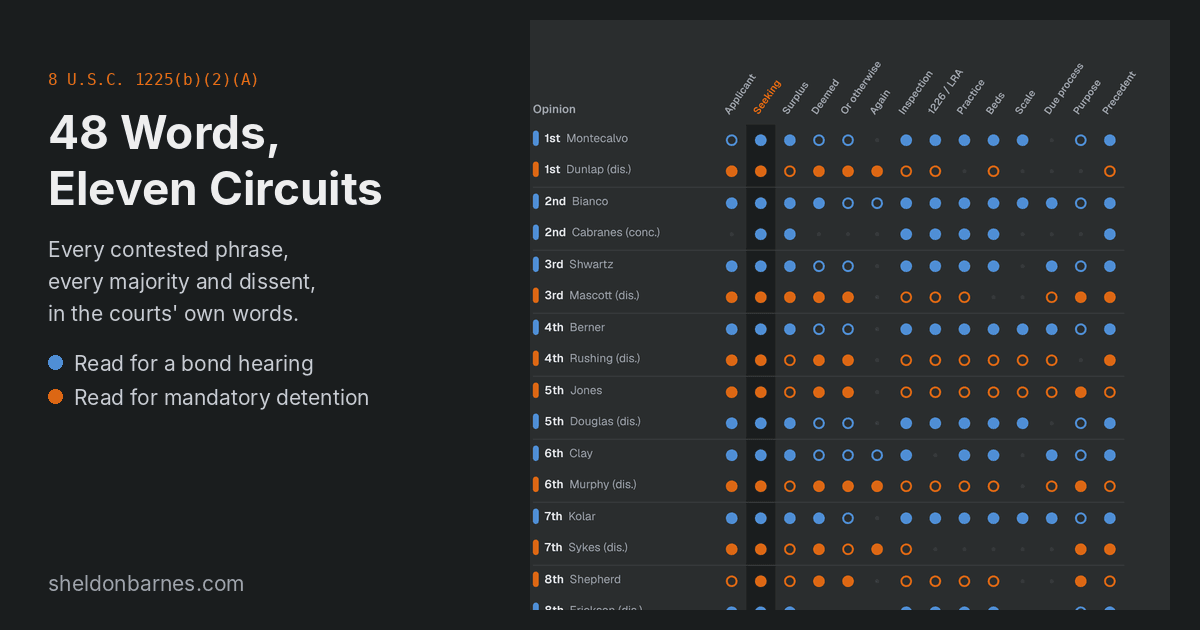
Every numbered circuit has now ruled. Nine rejected mandatory detention: the First, Second, Third, Fourth, Sixth, Seventh, Ninth, Tenth, and Eleventh. Two upheld it: the Fifth Circuit in Buenrostro-Mendez v. Bondi on February 6, 2026, and the Eighth Circuit in Herrera Avila v. Bondi on March 25, 2026. I found no D.C. Circuit decision on the question.
The judges were not close to unanimous. Seven of the nine decisions for the detainees drew a dissent, and both government wins drew one too. Only the Second Circuit, where Judge Cabranes concurred, and the Tenth Circuit were free of a dissenting vote.
The Court chose the Second Circuit's April 28 decision in Barbosa da Cunha v. Freden as its vehicle. The government had asked for something else. Its petition urged the Court to hold this case and take the Sixth Circuit's Lopez-Campos v. Raycraft (now Putra v. Lopez-Campos, No. 25-1415) instead, because that case also presents a due process question. The Court granted the Second Circuit case, which presents only the statutory question. The government's Sixth Circuit petition and the detainees' Fifth Circuit petition (Buenrostro-Mendez v. Blanche, No. 26-43) were distributed for the same conference and show no action since, which is consistent with the Court holding them for this case, though neither docket says so.
To see how each court read the statute itself, phrase by phrase and in the judges' own words, see the companion statute map.
What the numbers show
Interactive data
Detention, bond, and the courts, by the numbers
Hover or tap a chart for values. Every series links to its source and downloads as CSV.
People held in ICE detention
Average daily population by month
Vertical lines mark: ICE memo, July 8, 2025; Yajure Hurtado, Sept. 5, 2025.
ICE has not published detention statistics after July 11, 2026. September 2025 runs through Sept. 20 and July 2026 through July 11.
Source: ICE detention statistics, compiled by the Deportation Data Project and TRAC. Retrieved October 2026.
Each tab above tells part of the story, and each one links to its source.
Detention. ICE held an average of 40,203 people a day in January 2025, 58,317 in July 2025, and 71,937 in January 2026, the highest monthly average in a series that begins in October 2018. The previous high was 55,238 in August 2019. Through all of it, between about 69 and 74 percent of the people in detention had no criminal conviction.
Bond hearings. Immigration judges granted bond in 34 percent of hearings in June 2025, 25 percent in July, and 16 percent in September. Since October 2025 the monthly rate has ranged between 26 and 40 percent, and it was 29 percent in August 2026.
No jurisdiction denials. This chart isolates the mechanism. Counting bond decisions made on the merits or on jurisdiction, about 4 to 5 percent were denials for lack of jurisdiction in fiscal 2019. By September 2025 that share was 53 percent, and it was 53 percent again in December 2025. It then fell, to 34 percent in February 2026 and 15 percent in June 2026. These figures are my own calculation from the EOIR case records published by the Deportation Data Project, so treat them as analysis rather than an official statistic.
Releases. Releases on bond set by an immigration judge fell from 2,388 in June 2025 to 837 in August and 433 in the first twenty days of September. Starting in October 2025, ICE began reporting a new release category, "court ordered," which grew from 119 that month to 2,017 in May 2026, roughly matching bond releases.
Habeas petitions. Detainees filed 422 federal habeas petitions in all of 2024. They filed 281 in July 2025 alone, and 9,115 in March 2026. ProPublica counts 85,252 such petitions since January 2025. When immigration judges stopped hearing bond requests, the bond question moved to the federal district courts.
Border crossings. This tab tests a policy argument that sits beside the government's reading. Several dissenting judges, including Judge Murphy in the Sixth Circuit and Judge Mascott in the Third, argued that applying 236(a) to people who evaded inspection treats them better than people who present themselves at a port of entry, undercutting what Congress meant to do in 1996. The data cannot measure that comparison directly, but they can test a related claim: if the availability of bond drew people across the border, crossings should move with the bond rule. That rule stayed the same from April 1997 to July 2025. Across the full fiscal years in that span, 1998 through 2024, annual Border Patrol apprehensions at the southwest border ranged from 303,916 in fiscal 2017 to 2,206,054 in fiscal 2022. Monthly apprehensions fell from 249,740 in December 2023 to 56,400 in July 2024, after Mexico stepped up interdiction and the June 2024 asylum rule took effect. They were 46,609 in November 2024 and 29,105 in January 2025, then dropped 71 percent to 8,349 in February 2025. From February 2025 through January 2026 they stayed between 4,592 and 8,724 every month. There is no visible break at July 8 or September 5, 2025.
What the data cannot tell you
These charts do not decide what "seeking admission" means. That is a question of statutory text, and it is the only question this case presents.
The data also have real limits. Apprehensions count attempts, not successful entries, and repeat crossers inflate the Title 42 years from 2020 to 2023. ICE has not published detention statistics after July 11, 2026. The no jurisdiction series is derived from case records rather than published by EOIR.
The appearance data cut both ways, and I want to say so plainly. EOIR's own yearbooks show in absentia rates between 31 and 42 percent for respondents released from custody in fiscal 2012 through 2016, and the government will cite numbers like these. But that "released" category covers anyone released once proceedings began, whether on DHS or immigration judge bond or on recognizance, including recent border arrivals, not just people released on bond after an interior arrest, and GAO concluded in December 2024 (GAO-25-106867) that in absentia orders cannot reliably measure whether people appear. Ingrid Eagly and Steven Shafer's study of immigration court records from 2008 to 2018 found that most nondetained respondents attended all of their hearings, and that represented respondents almost always did.
My take
I expected the border data to help the government. They do not. If bond hearings were a meaningful draw, you would expect crossings to track the bond rule. Instead the rule held steady for twenty eight years while crossings swung by a factor of seven, and the 2024 and 2025 collapse came months before the July 2025 memo, with no further decline after it.
What the policy did change shows up everywhere else on this page: record detention, a bond grant rate that fell by more than half within three months, and tens of thousands of habeas petitions that moved the bond decision from immigration judges to federal district courts.
None of that answers the statutory question, and a good brief will not pretend otherwise. But the idea that bond rewards unlawful entry runs through the dissents on the government's side, and the Court will hear it again. That is where I think an amicus brief can add something. Supreme Court Rule 37.1 asks amici to bring the Court relevant matter the parties have not already raised. My brief would test that premise against the government's own data, carry the caveats honestly, and stay within the word limit in Rule 33.1(g).
The Court has not yet set a briefing schedule. I will keep this map and these charts current as the case moves, and I will post the sample brief here when it is done.
Sources and method
Circuit decisions link to each court's own website and to Justia; the Supreme Court materials link to the docket for No. 26-104 and the October 1, 2026 order list. Westlaw citations will be added.
Detention, book in, and release data come from ICE's detention statistics, as archived and compiled by the Deportation Data Project and TRAC. Bond hearing counts come from TRAC's bond hearing tool. The no jurisdiction series is my analysis of EOIR records published by the Deportation Data Project. Habeas counts are tallied from the ProPublica Habeas Tracker and cross checked against TRAC. Border data come from CBP, with monthly figures compiled by WOLA Border Oversight. Appearance figures come from EOIR's FY2016 Statistics Yearbook, GAO-25-106867, and Eagly and Shafer.
Every chart's data can be downloaded as a CSV from the chart itself. All figures were retrieved in October 2026. If you spot an error, tell me and I will fix it.
Share this post