Who Follows Whom: An Influence Map of the Bond Circuit Split
Somewhere in the Federal Reporter, there is a zoo.
I did not notice it at first. I was reading eleven circuit opinions about a single immigration statute, expecting dry argument about one phrase, and instead the animals began to appear. An elephant, to start, because Congress does not hide elephants in mouseholes, and for months eleven courts could not agree on whether this particular elephant had been stuffed into this particular hole. Then a whole menagerie loose in the pages of the United States Code: a man who sneaks into Yankee Stadium, a perverse incentive to enter at an unlawful rather than a lawful location, a seismic shock running through the detention system, a warning that the border is now everywhere, and, in a quieter aside, the strange suggestion that tomatoes and cucumbers might be deemed vegetables.
None of it is mine. I invented none of it. Judges wrote every word, borrowing some from the Supreme Court and, it turns out, a great deal from each other. That was the thing I could not see until I stopped reading and started drawing. The same images kept migrating, circuit to circuit, dissent to dissent, an elephant passed hand to hand down the line. A phrase coined in one courtroom in April would surface, unattributed and slightly reshaped, in another in August.
So I mapped it. I put all twenty-one opinions on a ring and drew a line every time one court reached for another, green where it agreed and red where it did not, and watched the conversation light up. The scoreboard says nine to two. The map says something more interesting: that most of a nation's circuit courts were quietly reading over each other's shoulders, trading the same handful of metaphors like playing cards.
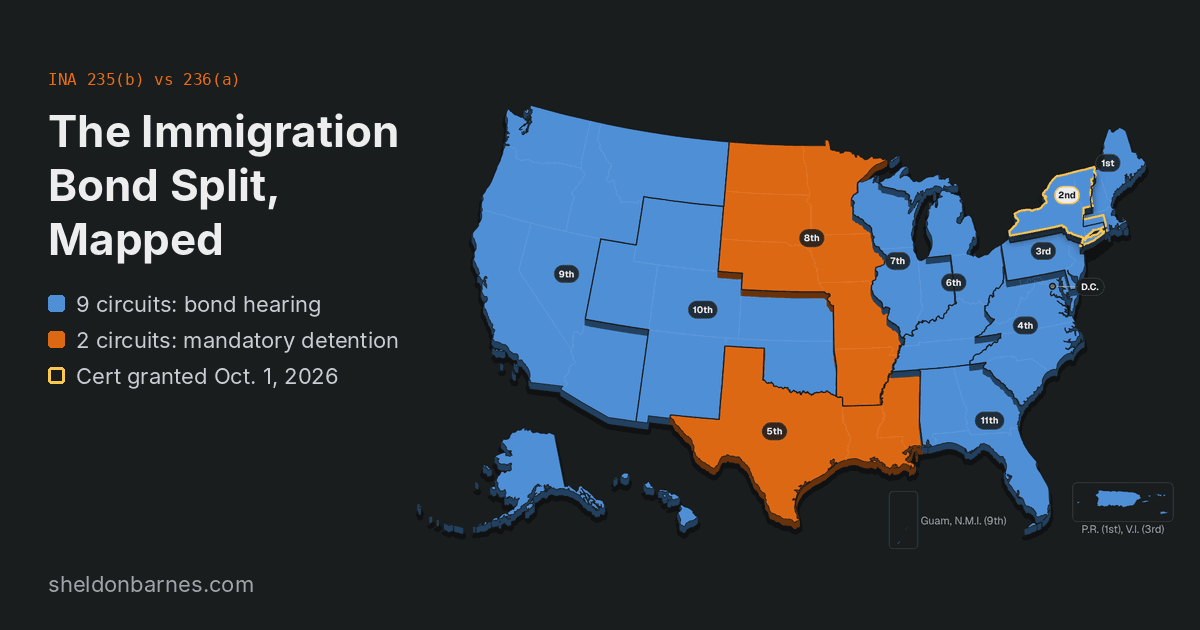
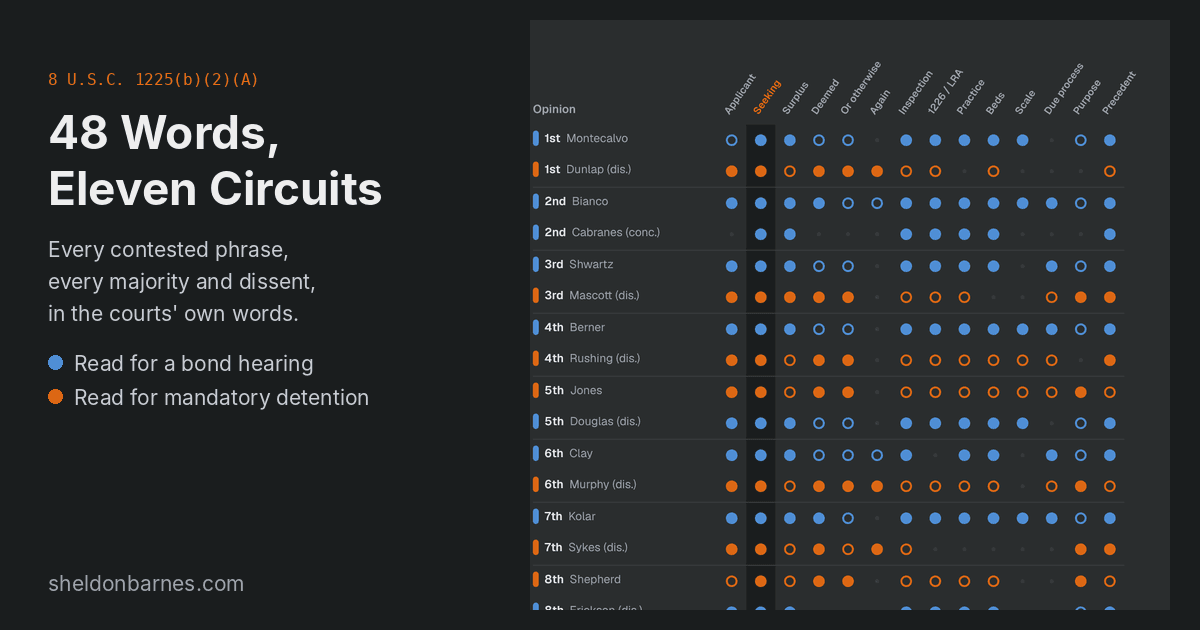
My circuit map shows where each court landed, and my statute map shows how each court read the words. This last piece shows the conversation itself. Come find the elephant.
How to read it
Twenty-one opinions sit on the ring, eleven majorities, nine dissents, and Judge Cabranes's concurrence, placed in the order they were decided. Blue is a bond reading, orange is a mandatory-detention reading, and a hollow node is a dissent or concurrence. Each separately authored opinion is its own node, so one decision can appear two or three times on the ring, and the set is the eleven merits panel decisions and the separate writings filed with them, not the later orders on rehearing. The three buttons switch what the links mean.
Citations draws who cited whom. A green arc means the citing opinion adopts or agrees with the one it points to, red means it rejects it, and a dashed gray line means it distinguishes or just discusses it. Tap any node to open it and read every relationship in the court's own words, with a pin cite. Bigger nodes are the ones other courts follow most.
Shared language lights up the opinions that use the same distinctive phrase. Each phrase is marked as coined in this litigation or borrowed from an earlier source, so you can tell an original turn of phrase that spread from a stock quotation everyone reached for.
Shared authority lights up the opinions that lean on the same Supreme Court case, colored by which side they cite it for.
Influence map
How the circuits talk to each other
Tap a node to open it
Hover to isolate one opinion's links. Each opinion shows who it relies on and who relies on it.
Most followed opinions
Sources: the eleven courts of appeals' slip opinions. Each citation is classified by how the citing opinion treats the cited one, with the court's own words and a pin cite checked against the Westlaw version. Classifications are my reading; close calls could go either way.
What the map shows
Of the 94 citations between these opinions, 55 adopt or agree, 20 reject, and 19 are neutral. One caution before any of this: the count of citations is objective, but the label on each one, adopt or reject or something in between, is my reading, and the close calls could go the other way. The shape that produces is lopsided on purpose.
The bond side built a dense web of citation; the government side did not. The nine bond-side majorities cite each other again and again with joinder language, "we join the Second and Eleventh Circuits," "we agree," "we adopt." By the time the Third and Fourth Circuits wrote in late summer, they were engaging most of what came before, the Third citing nine of its sibling circuits and the Fourth all ten. The two government majorities, the Fifth and Eighth, sit off to one side. Density is not the same as agreement, but the shape is unmistakable: one side is talking to itself constantly, the other barely at all. The Eighth leans almost entirely on the Fifth, and after that the government reading stops spreading. Later courts cite the Fifth and Eighth constantly, but mostly to answer them, which is why so many of the arcs pointing at those two nodes are red.
The dissents formed their own network. This is why the map tracks opinions rather than whole courts. Judge Murphy's dissent in the Sixth Circuit leans on Judge Lagoa's dissent in the Eleventh. Judge Bea's dissent in the Ninth adopts Judge Murphy's. Judge Dunlap's dissent in the First expressly adopts Lagoa, Murphy, and Sykes. The judges who would hold for mandatory detention were quietly building a bench of their own, citing each other's separate writings the way the majorities cited each other's holdings.
Some phrases traveled. The "elephants in mouseholes" line, borrowed from the Supreme Court's Whitman decision, shows up in nine of the twenty-one opinions, used by the bond side as a weapon and thrown back by the Fifth Circuit, which insisted its reading "is no mousehole." The warning that the government's view would mean the largest mass detention in the nation's history, coined in this litigation, spread to eight opinions. The college-applicant analogy, first appearing in the Fifth Circuit's opinion in this litigation, was picked up and then rejected by four later courts.
Both sides fought over the same precedents. Jennings v. Rodriguez appears in nineteen of the twenty-one opinions, cited by both sides for opposite conclusions. Nielsen v. Preap and Zadvydas v. Davis are close behind. Loper Bright shows up in eight opinions and is claimed by no one, cited by everyone only as the neutral standard for reading a statute.
My take
The scoreboard says nine to two, and that makes the question look nearly settled. The influence map complicates that. Almost all of the reasoning on the winning side flows from one early decision, the Second Circuit's, and almost all of the losing side flows from another, the Fifth. Strip away the opinions that simply adopt one of those two, and the split is closer to a disagreement between two thoughtful courts that the rest lined up behind. And now the Supreme Court has entered the conversation, granting review on October 1 in Rhoney v. Barbosa da Cunha, No. 26-104, which puts the nine to two split directly before it. That is worth remembering when the government argues, as it surely will, that nine circuits cannot all be wrong. To my eye the map suggests a different reading, that nine circuits can be nine readings of the same two or three opinions, though that is an argument about the network, not a fact the network proves.
It also tells me where an amicus brief is useful and where it is not. The textual arguments have been made and remade twenty-one times, and the map shows them converging. What has not been tested anywhere in this conversation is the empirical premise underneath the government's reading, the idea that bond availability drew people across the border. That is the gap the data speaks to, and it is where I plan to aim.
Method and sources
The nodes are the twenty-one opinions. An edge is drawn when one opinion cites another of these cases, and I classified each as adopts, agrees, distinguishes, rejects, or discusses after reading the passage in context. Every quotation is copied verbatim from the court's slip opinion and carries a pin cite checked against the Westlaw version. The shared-language and shared-authority layers come from the same reading, counting a phrase or a precedent only where it genuinely recurs, not where it merely tracks the statutory text.
The classifications are my own judgment, and the close calls, a citation that both leans on a case and criticizes it, could reasonably be labeled either way; those are marked as mixed. The network detection was built from the opinions themselves and then verified by hand, the same process behind the other two maps. If you think I have a link miscast, tell me and I will look again.
Share this post