When Private Corporate Power Becomes a National Security Liability
What happens when a private CEO has the power to disrupt America's national security capabilities?
It is 2028.
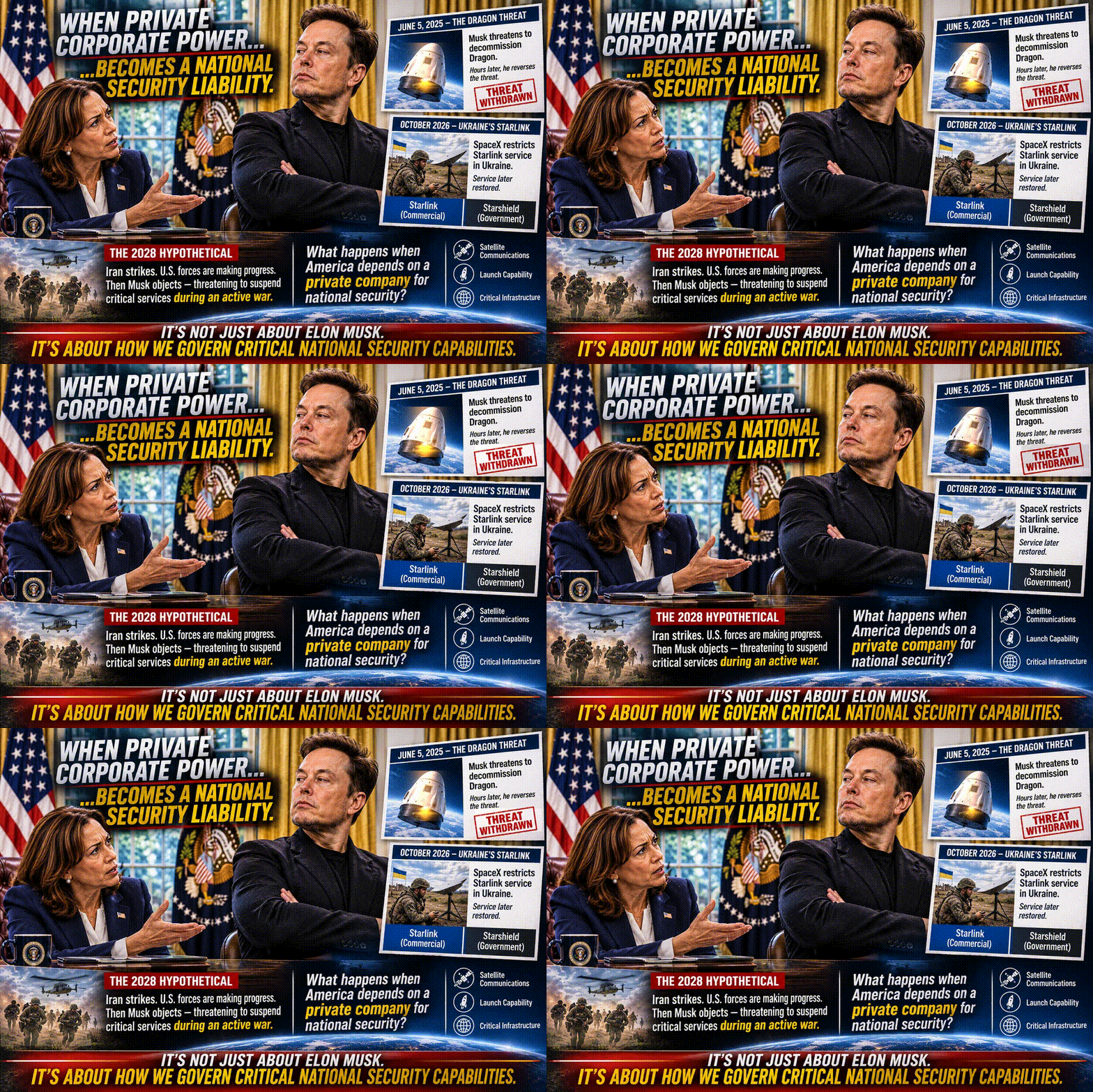
Iran has launched devastating attacks against American interests around the world following a catastrophic miscalculation. The Democratic President orders a ground campaign. American forces are deployed, and the operation is making significant progress. U.S. forces are achieving their objectives, pushing deeper into enemy territory, relying heavily on satellite communications, intelligence, space-based capabilities, and commercial launch infrastructure.
Then Elon Musk objects.
Following a disagreement with the administration, Musk threatens to suspend commercial services supporting U.S. government space operations and restrict access to satellite capabilities supporting the military campaign.
Suddenly, the President faces a decision that has little to do with military strategy and everything to do with private ownership of critical national security infrastructure.
Does the administration negotiate? Invoke emergency powers? Compel continued service? What happens if a private company's CEO decides his company will no longer support capabilities the military depends upon?
This might sound like political fiction. But the underlying concern is not theoretical.
Example 1: June 5, 2025 — The Dragon threat
During his public dispute with President Trump, Musk announced that SpaceX would begin decommissioning its Dragon spacecraft immediately following the President's threat to cancel government contracts.
Dragon was critical to NASA's ability to transport astronauts to and from the International Space Station.
Hours later, Musk reversed his position, stating that SpaceX would not decommission Dragon. The threat was never carried out. But the message was unmistakable: a private executive could threaten to withdraw a capability on which the government heavily depended.
Example 2: October 2026 — Ukraine's satellite restrictions
Ukraine experienced actual restrictions affecting its satellite communications during its war with Russia. Frontline operations, drone missions, and logistics were disrupted.
Musk subsequently acknowledged that SpaceX had throttled commercial Starlink service, arguing that Ukraine had violated its terms of service. Ukraine also reported disruptions involving Starshield, but responsibility for those restrictions was disputed. Musk maintained that Starshield was controlled by the U.S. government.
On October 24, President Zelenskyy announced that Starlink and Starshield services had returned to the speeds needed for operations.
These are two different examples: a threat to withdraw a critical spaceflight capability and actual restrictions affecting satellite communications during an active war.
Now return to the hypothetical.
What happens when the country dependent on these capabilities is the United States itself?
This is not fundamentally an Elon Musk problem. It is a national security governance problem.
We need to distinguish between investigation, legislation, and regulation.
Investigations establish facts. Legislation establishes authority and obligations. Regulation establishes safeguards before a crisis occurs.
We need continuity requirements, government emergency access, infrastructure redundancy, enforceable contractual protections, and safeguards against excessive concentration of control over critical national security capabilities.
I believe in private enterprise, innovation, and public-private partnerships. SpaceX has delivered extraordinary capabilities for America.
But there is a difference between allowing private companies to build critical national infrastructure and allowing national security to become dependent on the discretionary decisions of one corporate executive.
Legislate before the conglomerate, not after
The reactive path is a breakup after the damage is done. The proactive path is a line drawn before any single company sits astride the entire stack. Picture one firm — call it X — that owns the data centers training the models, the chips those models run on, the robots coming off its factory floors, the social network where the country argues with itself, and the rockets and satellites carrying military communications to the front. No law today stops that company from forming. Each acquisition looks reasonable on its own, and the danger is only visible once the pieces are assembled — by which point the leverage is already built and a crisis is the wrong time to discover it.
Proactive legislation would treat concentration across critical national security capabilities as its own category of risk, distinct from ordinary antitrust, which asks mostly about consumer prices. It would cap how much of that stack — launch, satellite communications, compute, advanced chips, and the data infrastructure beneath them — any single entity may control, and require structural separation where those lines are crossed. The aim is not to punish success or single out one founder. It is to ensure that no President, of either party, ever has to weigh a war plan against the mood of a single executive, because the law never let that much of the nation's security run through one set of hands in the first place.
Civilian oversight, with transparency
Structural limits decide who may own the stack. Oversight decides how it is run while it carries the nation's defense. So the same legislation should place clear civilian leadership over these capabilities for as long as a private company provides them. Any decision capable of degrading, suspending, or redirecting a national security capability — throttling a satellite network over a battlefield, decommissioning a spacecraft the government depends on, cutting access during an active operation — would have to pass through civilian oversight and be disclosed, in real time to the appropriate authorities and, as far as security allows, on the public record. The authority of the President and Commander in Chief cannot sit downstream of a corporate decision made in private. If a private executive can effectively veto a military operation by flipping a switch, then that switch belongs under the same civilian control, and the same duty of transparency, as every other instrument of national power.
The question isn't whether Elon Musk has too much power. The question is whether America has allowed any private individual to acquire too much control over capabilities essential to its national security.
Share this post
Tagged