OpenFold3 on NVIDIA AI Enterprise: A Voice-Guided Molecule Viewer in Your Browser
You can explore the human genome in a web browser. You can search a chemical structure from your phone. You can spin an astronomical object in a Wikipedia article. But until this week, you couldn't walk through the three-dimensional structure of a folded protein the same way — not without installing PyMOL, learning UCSF Chimera, or holding a PhD in structural biology.
That's the gap I wanted to close.
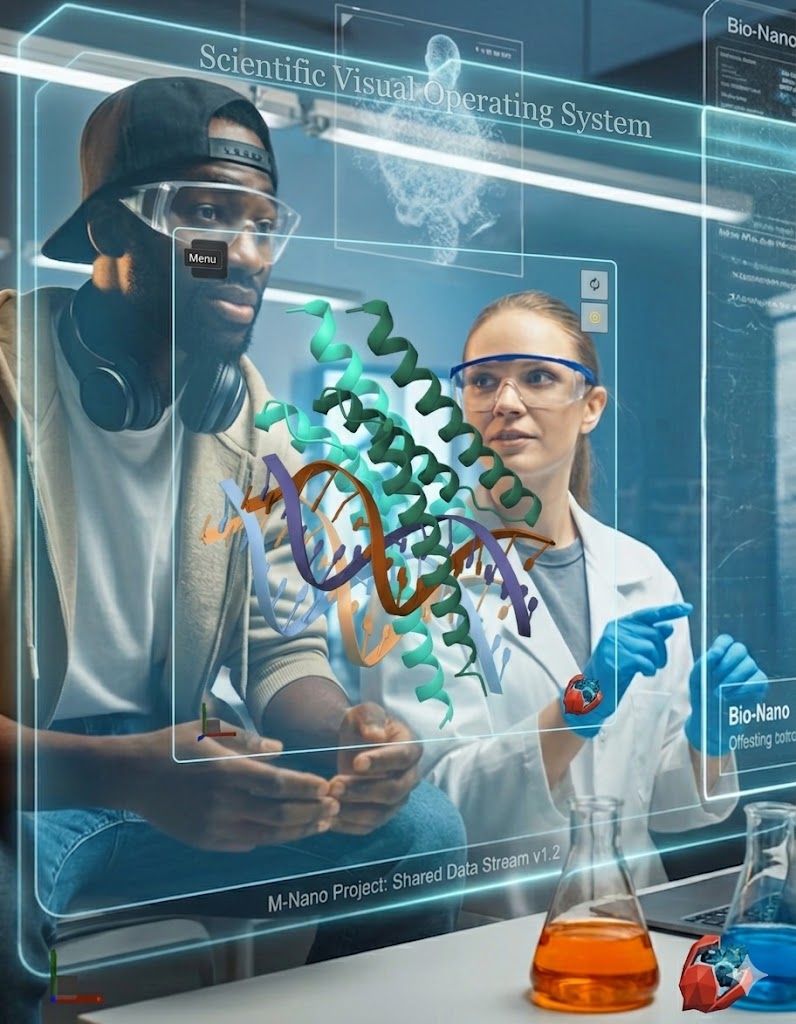
I built a voice-guided molecule viewer that renders real protein structures in the browser, narrates them like a museum docent, and lets anyone — a curious student, a clinical researcher, a medical writer — ask it questions out loud. The predictions come from OpenFold3. The delivery layer is NVIDIA AI Enterprise. The glue is a single web page anyone can open.
This post is about how those pieces fit together, and why that matters for the next decade of drug discovery.
What OpenFold3 is
OpenFold3 is a third-generation biomolecular foundation model that predicts the three-dimensional structures of molecular complexes — proteins, DNA, RNA, ligands — in a single pass. Give it a handful of sequences. It returns a folded structure.
That sentence sounds small. It isn't.
For most of the history of biology, determining the structure of a single protein complex was the kind of thing that took a graduate student five years, a synchrotron beamline, and a journal paper. The first wave of AI protein-folding models — AlphaFold 2 and its contemporaries — collapsed that timeline from years to hours, but they were narrow. They folded single proteins. They struggled with nucleic acids. They didn't reason jointly about a protein bound to its DNA target the way biology actually works in the cell.
OpenFold3 handles the joint problem. Protein plus DNA. Protein plus RNA. Protein plus a small-molecule ligand. That's the form biology takes when it's doing anything interesting — the transcription factor gripping its operator, the polymerase threading a template, the drug occupying its target's binding pocket. A model that folds complexes is a model that can reason about function.
Why NVIDIA AI Enterprise matters
Having the model is half the problem. Shipping it to people is the other half.
A state-of-the-art foundation model in a Colab notebook isn't a product. It's a demo. The moment you try to let real people use it — doctors, patients' advocates, pharmacologists outside research-group Slack rooms — you run into everything a notebook doesn't give you: authentication, quota, observability, regional availability, a predictable SLA, a billing line your CFO recognizes, a compliance story your legal team can approve.
NVIDIA AI Enterprise for Life Sciences is the layer that turns the model into infrastructure. The same inference endpoint I call from my laptop is the one a regulated pharma team can call from its validated cloud environment. The container, the microservice, the authentication, the rate limiting, the support contract — they're already solved. I didn't have to build any of it.
For an individual developer, that means I got to skip the entire "make the model callable" project and go straight to "make the model useful." For an enterprise buyer, it means you get one platform across Clara, Parabricks, BioNeMo, Riva, and the rest of the life-sciences stack — with a procurement story and an operational model that fits the way regulated industries actually run.
That's not a small thing. In pharma, the distance between "promising demo" and "approved production workload" is often measured in years. NVIDIA AI Enterprise collapses that distance because the platform is already through the approvals your team already did.
From sequence to 3D scene
The pipeline I built is embarrassingly simple. That's the point.
A sequence goes in. Two proteins bound to a short piece of DNA, or a transcription factor threading an operator, or any of the dozens of textbook complexes a teacher might want to show. OpenFold3, hosted on NVIDIA AI Enterprise, returns a folded structure as mmCIF — the standard format every molecular-biology tool understands — along with a set of confidence scores. pLDDT per residue. pTM. ipTM for the interface. The model is telling you not just what it folded, but how sure it is about each piece.
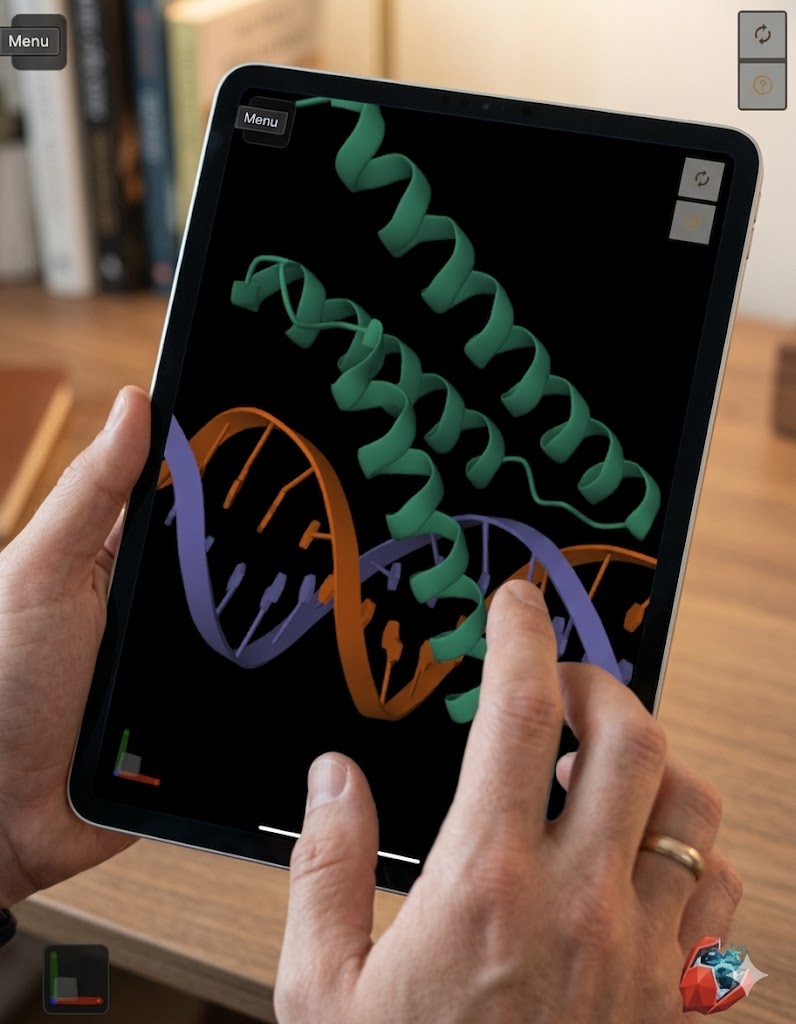
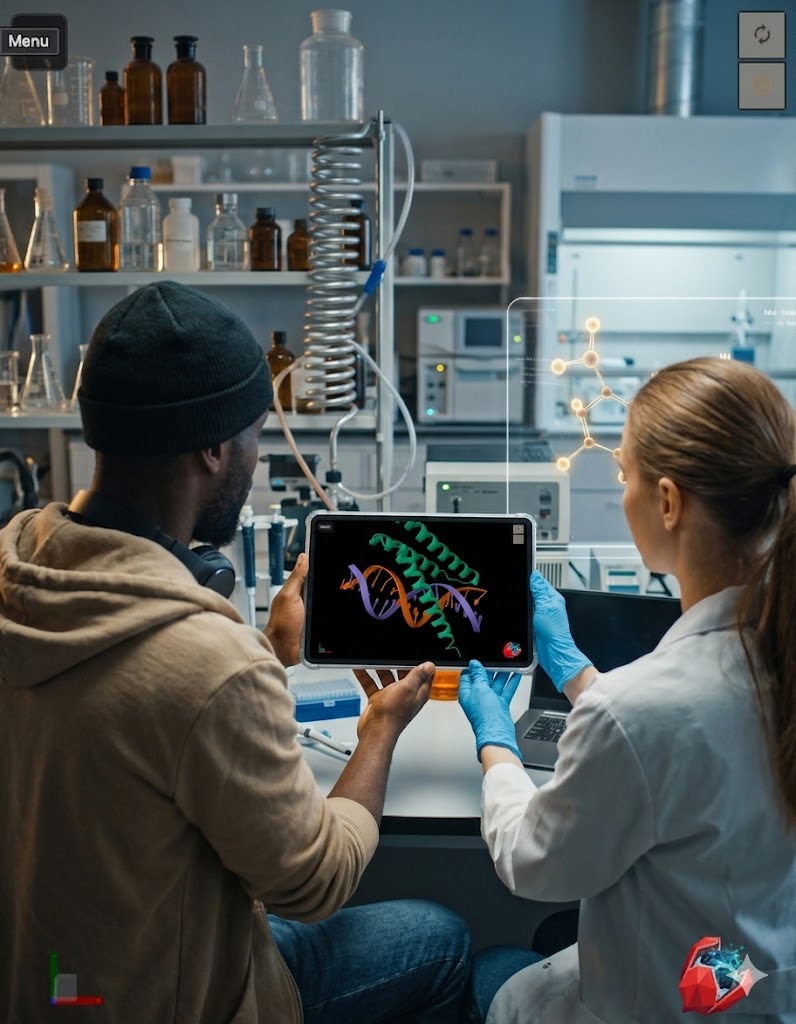
That JSON goes into the browser. The viewer renders it with Mol*, the open-source molecular visualization engine from the PDB. Proteins show up as rainbow cartoons; DNA strands draw themselves as double helices; confidence gets color-coded right onto the surface. What took a structural biologist a workstation, a site license, and twenty minutes of manual configuration now takes a page load.
No build step. No install. No login. Just the structure.
The part that matters: comprehension
Rendering a protein is a 2015 problem. The interesting problem in 2026 is helping someone understand what they're looking at.
The viewer I built has a voice assistant. You click the assistant's logo and ask it questions. "Walk through chain A." It highlights every amino acid in sequence, narrating which residue is which and what role that family of residues tends to play. "Focus on guanine three." It orbits the camera around that nucleotide so it's facing you. "Start the guided tour." It plays a ninety-second narrated walkthrough explaining what the complex is, why it matters, and what to look for.
You can ignore the voice entirely and use the sidebar. Every residue is a clickable chip. Every chain has a one-tap walkthrough button. Every metric is a card with a label a non-specialist can parse. On mobile, the chrome collapses into a drawer and the viewer fills the screen.
This is the part that takes the technology from impressive to useful. A structural biologist looking at the same rendering sees a transcription factor bound to its operator, reads the confidence scores, makes inferences about specificity. A medical student sees a protein hugging a piece of DNA, hears the words "positively charged lysines gripping the negatively charged backbone," and — for the first time, maybe — understands what "DNA-binding protein" actually means.
That's the accessibility dividend. It's the difference between a capability and a tool.
The Scientific Visual OS
This viewer isn't a one-off. It's the first concrete instance of a thesis I've been writing about for a while: the Scientific Visual Operating System — the idea that the same GPU-native rendering pipelines that turned game worlds into real-time clarity will, over the next decade, turn drug discovery into a fluid, interactive, explainable workflow.
Structural biology is the obvious first surface. It's visual. It's three-dimensional. It's been trapped inside specialist tools. OpenFold3 removes the "we need to determine a structure" bottleneck; NVIDIA AI Enterprise removes the "we need to deploy it" bottleneck; a web browser removes the "we need a PhD to run it" bottleneck. What's left is a medium where you can navigate molecular biology the way you navigate a city.
Pathway simulation comes next. Virtual cell models after that. Each one goes through the same transformation: from a specialist's tool behind a specialist's interface, to something a curious person can explore on their phone during a subway ride.
Try it
Two example complexes are loaded and ready — both folded by OpenFold3, both delivered by NVIDIA AI Enterprise, both rendered in your browser with no login.
Open it on your phone. Click the ackee-fruit logo. Ask it to walk you through chain A.
If you're a researcher, I want to hear what's missing for your workflow — evaluation metrics, confidence overlays, export formats, anything. If you're building on NVIDIA AI Enterprise for a different life-sciences problem, I want to compare notes. The viewer is meant to be the first concrete piece of a much larger Scientific Visual OS, and the only way that OS gets built is if more of us start shipping.
Share this post
Tagged