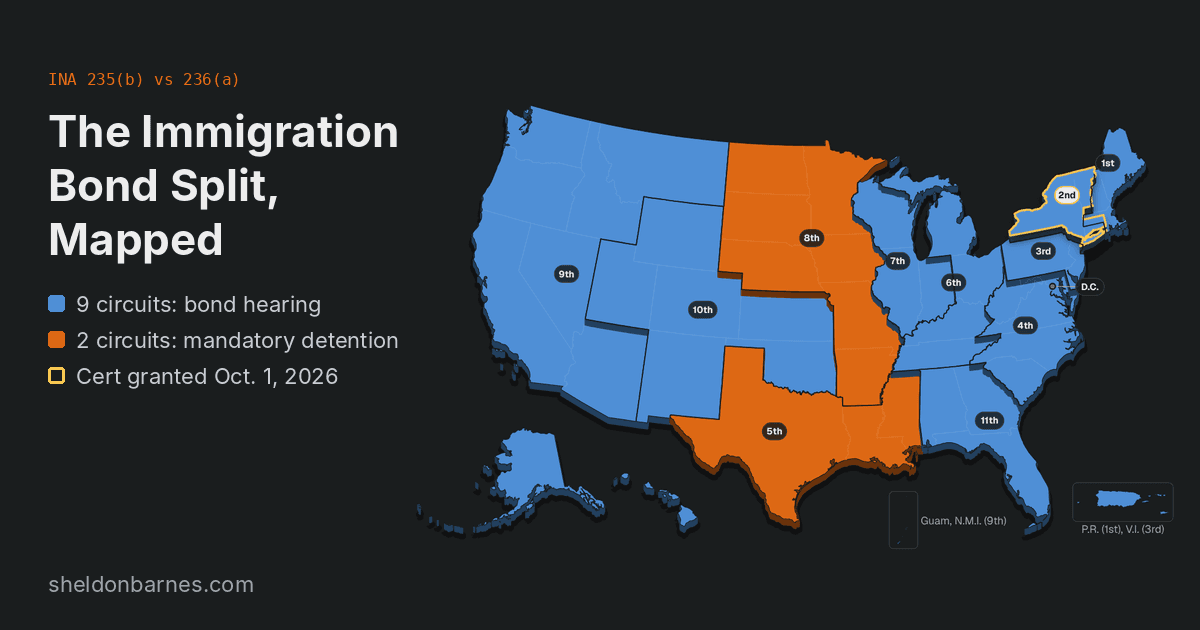
48 Words, Eleven Circuits: The Bond Statute, Mapped Phrase by Phrase
The Supreme Court agreed to decide one question in Rhoney v. Barbosa da Cunha: what 48 words in 8 U.S.C. 1225(b)(2)(A) mean. Every federal circuit except the D.C. Circuit has now read those words, along with a handful of neighboring provisions, and they have not read them the same way.
My circuit map shows where each court landed. This page shows how they got there. It puts the statute at the center and arranges the courts around it, phrase by phrase, so you can see which words carried each decision and which arguments each side never had to answer.
How to read it
Pick a provision from the tabs, then tap any underlined phrase. A reader pops up with the circuits across the top. Tap a circuit to see what its majority did with that phrase, and switch to the dissent where there is one. The small dots under each circuit show at a glance which opinions spoke to the point: blue for the bond reading under 1226(a), orange for mandatory detention under 1225(b)(2)(A). Arrow keys step through the circuits, and the menu at the top switches to another phrase without closing the reader.
Each opinion gets one of two labels. Relies on it means the opinion used the point to support its own conclusion. Answers the other side means it mainly rebutted the other side's use of the point. Every entry shows the court's own words, with a link to that page of the court's PDF. The grid tab shows all 21 opinions against all 14 arguments at once; tap any dot to open it.
Statute map
Tap a phrase to see how each circuit read it
The detention provision
INA 235(b)(2)(A)Subject to subparagraphs (B) and (C), in the case of an alien who is , if that is , the alien shall be detained for a proceeding under section 1229a of this title.
Underlined phrases open a reader with every circuit's treatment. The small number is how many of the 21 opinions argued about it.
What the map shows
Every opinion argued about "seeking admission." All 21 opinions, eleven majorities, nine dissents, and Judge Cabranes's concurrence in the Second Circuit, addressed the phrase. It is the center of the case, and the Court's question presented turns on it.
The two sides argue from different toolkits. The opinions reading the statute for mandatory detention build their case from the deeming clause in 1225(a)(1), which all nine of them rely on, from the phrase "or otherwise seeking admission" in 1225(a)(3), which eight rely on, and from IIRIRA's goal of ending the old entry anomaly, which six rely on. The opinions reading it for a bond hearing mostly treat those points as arguments to answer.
The bond side builds from somewhere else: the canon against surplusage, the border inspection setting of 1225, and nearly thirty years of executive practice, each relied on by all twelve opinions on that side. Eleven of the twelve also rely on the structure of 1226, including the 2025 Laken Riley Act, and on the absence of any detention capacity for millions of people.
Some arguments only ever ran one way. No opinion on the mandatory detention side relied on executive practice, detention capacity, the scale of the change, or constitutional avoidance. When those opinions addressed them, they answered them.
One textual argument barely registered. The word "again" in 1182(a)(9)(B), which Judges Dunlap, Murphy, and Sykes cited in dissent as proof that unlawfully present people are already seeking admission, came up in only five of the 21 opinions.
My take
This is the part of the project that matters most for the amicus brief I plan to write. The textual ground has been covered by 21 opinions. The Court will not lack for readings of "seeking admission," of the deeming clause, or of "or otherwise." A brief that offers a twenty-second reading is not adding much.
The map also shows where the debate is thin. The purpose argument, that IIRIRA meant to stop rewarding people who enter unlawfully over people who present themselves at a port of entry, is relied on by six opinions on the government's side and answered by eleven on the other. I found no opinion on either side that tested the premise behind it against what actually happened at the border. That is the kind of relevant matter Supreme Court Rule 37.1 asks amici to bring, and it is where the data I have already pulled comes in.
Method and sources
All quotations come from the slip opinions published on each court of appeals' own website, linked from every entry. Every quotation was checked word for word against the opinion text and against the part of the opinion it is attributed to; omitted citations are marked with an ellipsis. Each quotation carries a Bluebook citation with a pin cite, matched against the Westlaw version of the opinion: Federal Reporter pages for nine circuits, and Westlaw star pages for the Third and Fourth Circuits, which are not yet in the reporter. Tap Copy to grab any citation. The Ninth Circuit's opinion begins with a staff prepared syllabus, which is not part of the opinion and is never quoted here.
The one sentence summaries and the labels are my own classification after reading each passage in context, and a second full review checked every summary against the opinion. Reasonable readers could label a few close calls differently, especially where an opinion both answers the other side and builds its own point from the same passage. If you think I have one wrong, tell me and I will look at it again.
The statutory text is from 8 U.S.C. 1225, 1226, and 1182 as currently codified. Longer provisions are excerpted, with omissions marked.
Share this post