Agentic AI + Microservices: Scalable Intelligence in Pharma
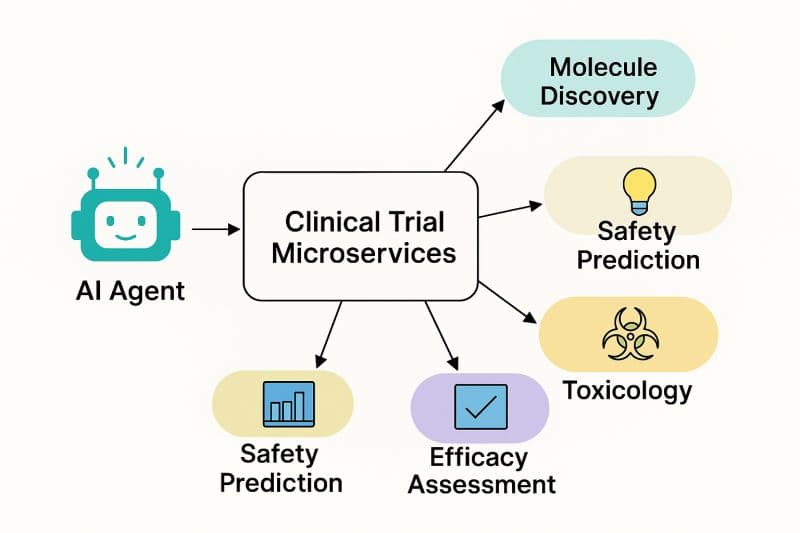
I believe there is a close alignment between agentic AI and microservices architecture. This pairing naturally supports modular, scalable solutions in pharma.
A worked example: feasibility scoring
Imagine this: an AI agent specifically tasked with calculating the Synthetic Accessibility Score (SAscore) — or another feasibility score — during molecule discovery. Instantly, scientists gain a clear sense of how feasible it is to synthesize a candidate molecule before setting foot in the lab. This kind of insight helps make early-stage decisions faster and smarter.
Another agent: toxicology prediction
Now picture another AI agent built to predict toxicology profiles, calling a microservice that leverages models trained on historical trials and public datasets. The agent doesn't just return a score — it delivers a rationale, surfacing prior examples and failure risks.
Why this architecture works
Each of these agents lives independently, scales horizontally, and communicates cleanly with the rest of the system through lightweight APIs. This is the power of microservices meeting AI agents:
- Flexible — swap models, add capabilities, deprecate without touching the whole stack
- Maintainable — clean boundaries mean each agent has one job and one owner
- Built for scale — horizontal scaling per agent, not per monolith
The goal
A modular platform that empowers scientists with AI-driven insights — without bottlenecks or black boxes. A platform that mirrors how scientists think and work.
We're not just talking buzzwords. We're building systems that think with us.
Share this post